
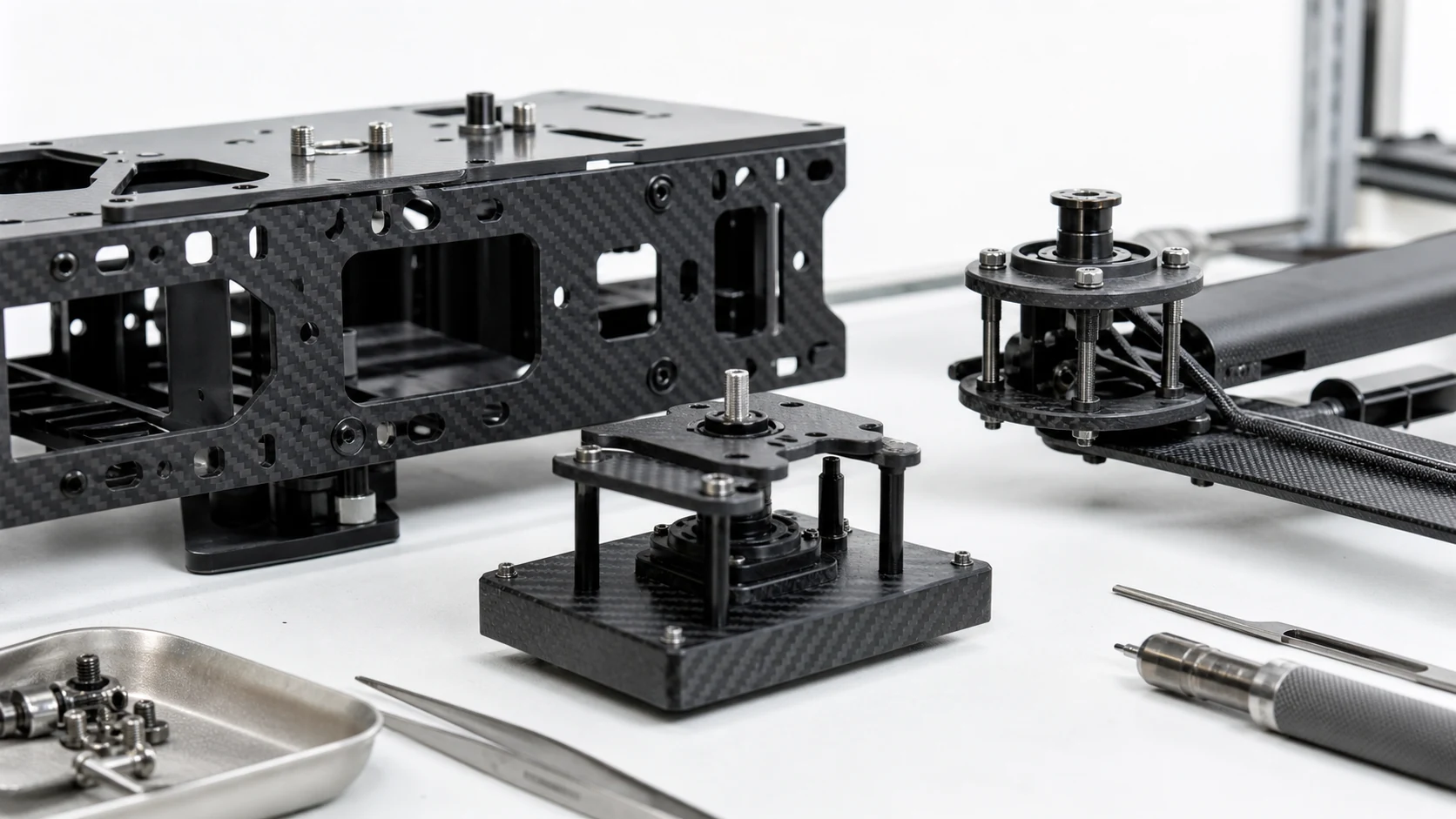
Lockheed Martin showed the development of the MORFIUS X-Rotor as a solution for countering swarms of drones. For CORDTEX, this news is important not because of the military context, but because of the engineering logic: lightweight design, rigidity, maintainability and stable geometry are again becoming key requirements for UAVs.
01
WHAT HAPPENED
A new stage in the development of the MORFIUS X-Rotor platform has appeared on the industry agenda. The focus is on a compact rotor system designed to perform in scenarios where weight, strength, assembly accuracy and design repeatability are important.
Even if a particular product does not relate to civil FPV, the trend itself is clearly visible: the UAV market is increasingly tolerant of random materials and increasingly requires engineered carbon components.
02
WHY IS THIS IMPORTANT FOR FPV
The FPV frame or power element of the UAV operates in environments with vibration, shock loads, frequent disassembly and limited weight. You can’t just “make it out of carbon” here. You need to understand the thickness, grain direction, edge quality, hole placement, beam stiffness and how the part behaves after several cycles of use.
Therefore, news about new rotor platforms is useful for CORDTEX as a guide: they show what requirements are becoming the norm - less weight, more precision, higher maintainability and less margin for error.
03
WHAT DOES THIS MEAN FOR CORDTEX FPV
For the FPV direction, this confirms the chosen logic: frames and components should be designed as a set of parts, and not as a collection of beautiful plates. Fitting, compatibility, beam geometry, quality of hole processing and clear assembly are important.
CORDTEX does not automatically transfer statements from industry news to product cards. But such publications help clarify what parameters need to be checked in new products and what scenarios should be taken into account when developing carbon components.
04
PRACTICAL CONCLUSION
Every gram of FPV has a price, but saving weight shouldn't compromise durability. For the client, this means a simple principle: choose not the most spectacular carbon, but a design where material, geometry and processing work together.
If the task is related to the frame, beam, plate or non-standard part of the UAV, you should start not with the picture, but with the working conditions: weight, load, fasteners, vibration, accessibility of repairs and the required safety margin.
05